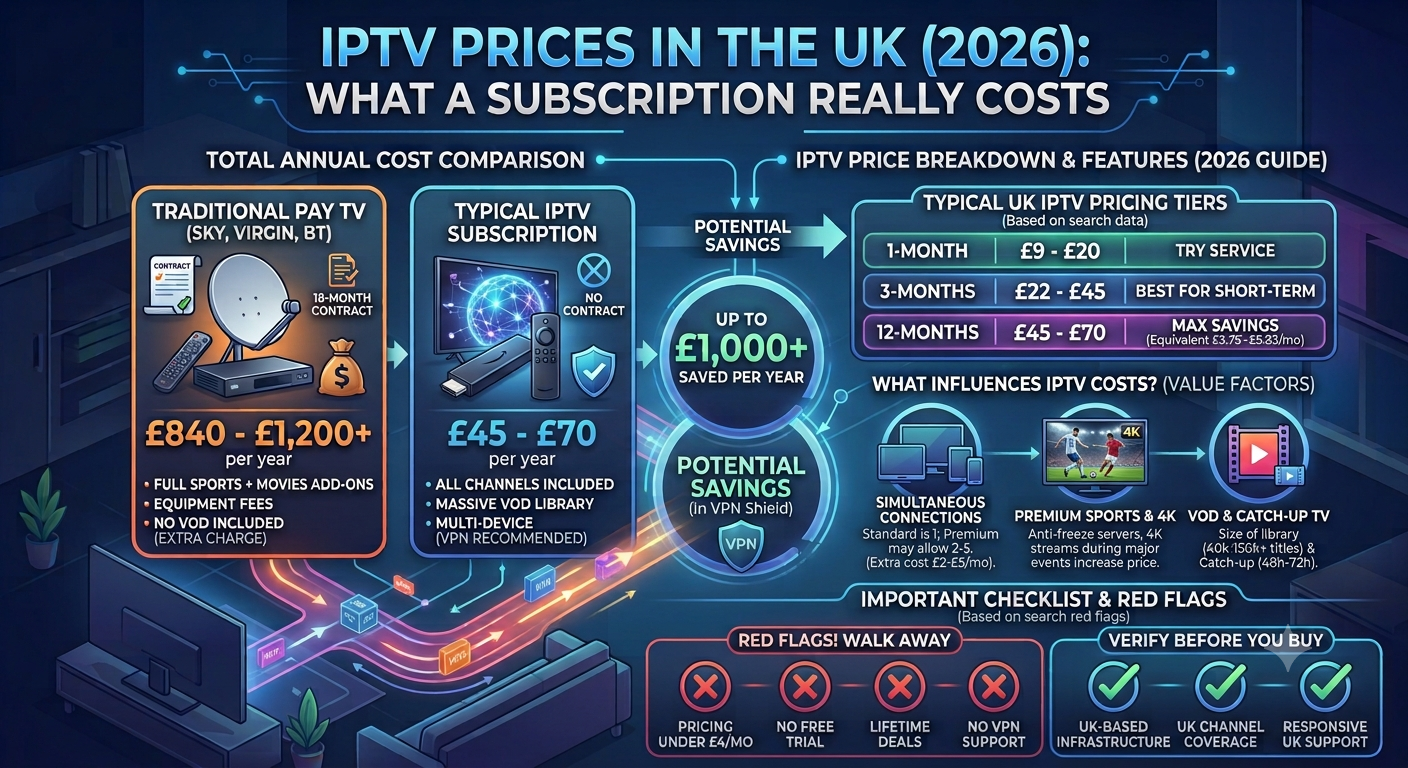
Search for IPTV UK prices and you'll find one provider charging £5 a month and another charging £40 for what looks, on the surface, like the same package. The gap rarely shows up until something breaks — the stream buffers during a big match, a support ticket goes unanswered for a week, or a renewal invoice arrives at double the first-year rate.
This IPTV UK prices guide sets out what a subscription actually costs in 2026, why prices diverge so sharply between providers, and how to judge whether a specific price is reasonable before paying for it. Rather than defending one price point as "correct," it works through the concrete factors — server capacity, channel count, support quality — that separate a fair price from a red flag.
Key takeaways:
- IPTV UK prices in 2026 typically span three tiers: roughly £5–£10, £10–£20, and £20–£40+ per month.
- Annual plans generally discount the monthly-equivalent rate by 20–40%, and a fair per-month rate should drop meaningfully with each longer commitment.
- An unusually low monthly-only price is more often a sign of cut server capacity than genuine savings.
- Most hidden costs come from renewal price hikes, per-connection charges, and unclear refund policies rather than the headline price itself.
What Is IPTV, and Why Do Prices Vary So Much?
IPTV (Internet Protocol Television) delivers live channels and on-demand video over a standard internet connection instead of satellite or cable infrastructure. Content is streamed as data through an app, rather than tuned in through a set-top box receiving a broadcast signal.
A provider hosts channel streams on servers and pushes them to a subscriber's device through an app — commonly Smart IPTV, an Xtream Codes-compatible player, or a dedicated app running on a Firestick, Android box, or smart TV. The app authenticates with a username and password or loads a playlist URL, then pulls the stream in real time.
Why Two Similar-Looking Packages Can Cost Very Different Amounts
Channel count is only one variable in the price. Server infrastructure, bandwidth capacity, content licensing arrangements, and the size of the support team all factor into cost, and an unusually low price is usually the result of cutting one or more of these corners. Anyone wanting to see this in practice can compare live plans on the OneIPTV4K homepage, which lays out channel counts, device compatibility, and support options alongside its pricing.
How Much Does IPTV Cost in the UK in 2026?
IPTV UK prices in 2026 typically fall into three tiers — roughly £5–£10, £10–£20, and £20–£40+ per month — with the difference reflecting channel count, server quality, and support level rather than a single fixed market rate.
Monthly Pricing by Tier
- Budget tier (£5–£10/month): Smaller channel lists, limited or no video-on-demand library, minimal support, often shared servers that struggle during peak viewing hours.
- Mid-range tier (£10–£20/month): Larger channel counts, frequently 10,000 or more, a working VOD section, more stable servers, and at least basic customer support.
- Premium tier (£20–£40+/month): High channel counts including 4K options, extensive VOD libraries, multiple simultaneous connections, and responsive support through WhatsApp, live chat, or a ticketing system.
Annual Subscription Pricing
Annual plans typically discount the monthly-equivalent rate by 20–40%. A mid-range provider charging £15 a month might price an annual plan at roughly £120–£150, rather than the £180 a full year of monthly payments would cost.
UK IPTV Pricing Tiers at a Glance
| Tier | Monthly Price | Yearly Price | Channels | Connections | Typical Features |
|---|---|---|---|---|---|
| Budget | £5–£10 | £50–£90 | 3,000–6,000 | 1 | Limited VOD, minimal support |
| Mid-Range | £10–£20 | £100–£180 | 8,000–15,000 | 1–2 | Working VOD, EPG, standard support |
| Premium | £20–£40+ | £180–£350+ | 15,000–25,000+ | 2–4 | 4K channels, large VOD library, priority support |
Where a Genuinely Well-Priced Provider Stands Out
Within the budget tier itself, there's a meaningful difference between a provider cutting corners to hit a low price and one simply passing on the savings of a longer commitment. OneIPTV4K's pricing is a useful example: paying monthly costs €10.99 (roughly £9.45), sitting comfortably inside the budget tier above rather than suspiciously below it. Committing to a longer term brings the effective monthly cost down further still.
| Term | Total Price | Approx. GBP | Effective Per-Month Cost |
|---|---|---|---|
| 1 month | €10.99 | ~£9.45 | ~£9.45/month |
| 3 months | €21.99 | ~£18.90 | ~£6.30/month |
| 6 months | €34.99 | ~£30.10 | ~£5.02/month |
| 12 months | €49.99 | ~£43.00 | ~£3.58/month |
That progression — a fair single-month rate that drops meaningfully with each longer commitment — is the pattern to look for. It reflects genuine volume pricing rather than an unsustainably low number likely to come with server or support compromises attached.
IPTV vs Cable, Satellite, and Streaming Apps: A UK Cost Comparison
The more useful comparison for most UK households isn't between IPTV providers — it's between IPTV and whatever they're already paying for.
IPTV vs Sky and Virgin Media
Sky and Virgin Media packages commonly run from roughly £30 to £80+ a month once sports and premium film add-ons are included, often tied to an 18-month contract. A well-priced IPTV subscription covering a comparable channel range can cost a fraction of that, though it comes without a broadcaster's official support structure or the same regulatory guarantees.
IPTV vs Stacking Multiple Streaming Apps
Combining Netflix, Amazon Prime Video, and a sports app such as NOW TV can reach £40–£60 a month once each subscription is added up individually. Some households turn to IPTV specifically to fold that spend into a single payment and a single app.
| Service Type | Avg Monthly Cost (GBP) | Contract Length | Channel Count |
|---|---|---|---|
| Sky Q (with sports) | £50–£85 | 18 months typical | 200+ |
| Virgin Media TV | £35–£70 | 18 months typical | 150+ |
| Netflix + Prime + NOW TV combined | £40–£60 | Monthly, no lock-in | Varies by app |
| Mid-range IPTV | £10–£20 | Monthly or annual | 8,000–15,000+ |
What Actually Drives IPTV Pricing?
Higher IPTV prices aren't automatically a markup — server capacity, channel and EPG upkeep, connection limits, support availability, and VOD library size are the concrete costs that typically separate budget and premium tiers.
Server Capacity and Uptime
Premium providers invest in more server capacity and bandwidth headroom, which directly reduces buffering during high-demand events like televised football matches. Budget providers often oversell capacity relative to their user base, which is exactly why cheap plans tend to degrade when the most people are watching at once.
Channel Count and EPG Accuracy
A well-maintained Electronic Programme Guide, often built on the XMLTV data standard, takes ongoing work to keep accurate. Providers charging more are generally funding that upkeep, along with broader, better-organized channel lists.
Number of Supported Connections
Supporting more simultaneous streams per account requires additional backend capacity, which is reflected in the price gap between single-connection and multi-connection plans. Providers offering up to 3 or 4 connections on one account — OneIPTV4K's plans among them — are pricing in that additional backend load.
Support Availability and VOD Library Size
A provider offering 24/7 WhatsApp or live chat support is paying for staff hours a budget provider without any support channel simply isn't, and a large, regularly updated on-demand catalog requires ongoing content licensing and storage — both tend to track with the higher end of the pricing range.
Limitations and Risks of Cheap IPTV Pricing
A low headline price isn't inherently a problem, but an unusually low price relative to the budget tier itself is often a sign of cut server capacity, oversold user loads, or skipped licensing costs.
Is IPTV Legal to Use in the UK?
Using an IPTV app or device is not illegal in itself — the legal question is about the content being streamed through it. Streaming content the provider doesn't hold proper distribution rights for falls under UK copyright infringement law, and there is no register of "approved" IPTV providers. Verifying legitimacy comes down to checking a provider's transparency about content sourcing and reading independent reviews. Providers that publish a clear disclaimer and legal policy are generally easier to evaluate on this point than ones that don't.
Reliability Trade-Offs
Cheap plans are statistically more likely to go down during major live events, precisely the moment server load peaks and undersized infrastructure shows its limits first.
Common Pricing Problems and Hidden Costs
The most common hidden IPTV costs are renewal price increases after the first term, per-connection charges that add up faster than expected, and unclear or nonexistent refund policies.
Renewal Price Increases
A common pattern: a discounted first-term price followed by a substantially higher renewal rate, sometimes 30–50% more, once the introductory period ends. Confirm this in writing before the first payment — don't assume it stays flat.
Per-Connection Charges and Refund Gaps
Some providers advertise a low base price but charge more per additional connection than a competitor's flat multi-connection plan works out to overall, so comparing the full multi-device total avoids this trap. Refund windows also range from a few days to none at all once login credentials are issued, and this detail is often buried in the terms rather than stated on the pricing page.
How to Evaluate an IPTV Price Before Buying: Step-by-Step Guide
To judge whether an IPTV price is fair: test the service with a short free trial, calculate the true multi-connection cost rather than the base rate, confirm the renewal price in writing, and check independent reviews before committing to a longer plan.
- Request a free trial first. A 24-hour trial reveals actual stream stability far better than any advertised specification — OneIPTV4K's free trial is one example available before any payment is made.
- Compare price per connection, not per plan. Calculate the total cost for the number of devices actually needed, since single-connection pricing can understate the real cost for multi-device households.
- Check accepted payment methods. Card, bank transfer, and cryptocurrency each carry different levels of buyer protection.
- Read independent reviews. Forums like Reddit and review sites such as Trustpilot often surface reliability patterns a provider's own marketing won't mention.
- Get the renewal price in writing. Ask directly, before paying, what the price becomes once the introductory term ends.
Best Practices for Getting a Fair IPTV Price
- Buy annual plans only after a successful trial, since committing upfront removes the ability to walk away if the service underperforms.
- Bundle connections for multiple devices rather than buying separate individual subscriptions.
- Watch for seasonal discounts around New Year and Black Friday, which can bring premium-tier pricing closer to mid-range rates.
Common Mistakes to Avoid With IPTV Pricing
- Choosing on price alone and ignoring server quality, when the cheapest option isn't automatically the best value once buffering and downtime are factored in.
- Skipping the refund and cancellation policy before paying, rather than reading it beforehand.
- Paying for a full year upfront without testing first, when a trial period exists specifically to avoid that risk.
- Ignoring currency conversion costs, since some providers price in USD or EUR, adding an unexpected fee for UK cardholders.
Expert Tips for UK Subscribers
- Test with at least a 24-hour trial before committing to a longer plan.
- If paying by bank transfer, request a clear payment reference and confirm it before sending funds.
- Prefer providers who quote prices directly in GBP, or clearly show the GBP equivalent alongside EUR/USD pricing.
- Keep a written record of the agreed renewal price — an email or saved chat message is enough.
Frequently Asked Questions
What is the average price of IPTV in the UK? Most mid-range IPTV UK prices sit between £10 and £20 a month, or roughly £100 to £180 annually, with the gap generally reflecting server quality, channel count, and support level.
Is cheap IPTV worth the lower price? A budget-tier plan can handle casual viewing reasonably well but is more likely to buffer during high-demand events like live sport, since lower prices generally mean less server capacity per user.
Do UK IPTV prices include VAT? This varies by provider and isn't always stated clearly upfront, so it's worth checking directly whether the advertised price is VAT-inclusive.
Is an annual plan cheaper than paying monthly? Yes, in most cases. Annual plans generally run 20–40% cheaper than paying the monthly rate for twelve consecutive months.
Are there free, legal IPTV options in the UK? Broadcaster apps such as BBC iPlayer and ITVX offer free, licensed streaming, but they're separate from paid IPTV subscriptions and don't cover the same breadth of international or premium sports channels.
Why did my IPTV renewal price go up? Many providers set a discounted introductory rate that reverts to a higher standard price at renewal, so it's worth confirming this before the first payment.
Can I pay for IPTV in GBP directly, rather than USD or EUR? Many providers do offer GBP pricing or a clear GBP equivalent, though some default to USD or EUR, so confirming the currency before paying avoids an unnecessary conversion cost.
Why does a second connection usually cost less than the first? Additional simultaneous connections draw on the same account infrastructure rather than requiring a wholly separate subscription, so providers typically price them at a lower incremental rate.
Is a more expensive IPTV plan always the better choice? Not automatically. Server stability, support responsiveness, and independent reviews affect day-to-day viewing at least as much as price does.
Does a higher channel count mean better value? Not on its own. A smaller, well-curated and reliably streamed channel list is often better value than a larger one riddled with dead links or duplicate channels.
What's the difference between IPTV pricing and IPTV reseller pricing? Reseller pricing is typically based on bulk credits purchased upfront, which the reseller then allocates to their own customers at a retail markup.
Can I try IPTV before paying for a full subscription in the UK? Most reputable providers offer a short free trial, typically 24 to 48 hours, specifically so a subscriber can check channel stability before committing to a paid plan.
Conclusion
IPTV UK prices in 2026 span a wide range for identifiable reasons — server infrastructure, channel count, support quality, and VOD libraries all factor into what a provider charges. Rather than treating the lowest number as automatically the best deal, it's worth evaluating what sits behind the price: trial performance, renewal terms, refund policy, and independent reviews all shape whether a given rate represents genuine value. This IPTV UK prices guide covers the core evaluation framework, but pairing it with a direct trial remains the most reliable way to confirm a provider's pricing matches its actual performance. For current plans and a free trial to test stream quality before committing to any term, visit the OneIPTV4K pricing page.